Bonds for newbies

Ex Pat

Member
Hey,

My IPS says that I should start adding bonds into my portfolio at the end of they year.

What I put in my IPS (and now I have to actually understand and realize what this means in practice) is :

Bonds will be CHF-denominated, investment-grade, via a low-cost broad ETF with short-to-intermediate duration.

And I also got this advice from @Rttm

Uncorrelated assets combined with regular rebalancing lead to a much more stable portfolio (reducing volatility and, consequently, making a "lost decade" less likely), while also theoretically improving performance (see Shannon’s Demon: https://www.richmondquant.com/news/...tfolio-returns-can-be-created-out-of-thin-air).

The problem that I have is that I don't know where to start, and what those "CHF-denominated, investment-grade, via a low-cost broad ETF" bonds should look like.

Is it better to look only in government bonds, or also industrial bonds because Swiss companies tend to be stable?
 
What I put in my IPS (and now I have to actually understand and realize what this means in practice) is :
There are not many Swiss bonds ETF: https://www.justetf.com/en/search.h...-bonds&country=CH&sortOrder=asc&sortField=ter

My favorites are :
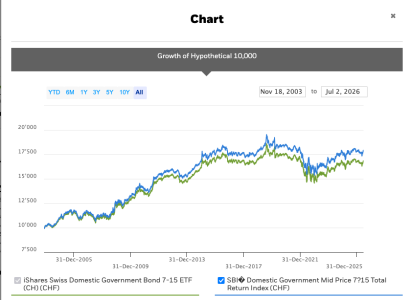
  • iShares Swiss Domestic Government Bond 7-15 (CH) for Government bond
  • iShares Core CHF Corporate Bond ETF (CH) CHF (Dist)
They do match all your criteria

But Swiss bonds have returned very little in the last 20 years with interest rates at all-time lows. It's not much better than cash :(
Is it better to look only in government bonds, or also industrial bonds because Swiss companies tend to be stable?
it's difficult to say honestly. Some people (like me) prefer government bonds only to reduce volatility, but others prefer a healthy mix of both. Given current interest rates, it's likely better to get a mix these days, at least in Switzerland.
 
My IPS says that I should start adding bonds into my portfolio at the end of they year.
I'm a bit confused. In this posting I read that you do not plan to have any bonds in your portfolio, since your 2nd pillar has enough bonds.
In any case, there is a discussion about bond investments in this thread.

But Swiss bonds have returned very little in the last 20 years with interest rates at all-time lows. It's not much better than cash :(
I agree with @Baptiste Wicht two bond ETFs. Still, if you look at past performance you would have a zero or negative performance if you invested at any time between roughly April 2016 and Nov 2021.
 

Attachments

  • ishares_corporate_bond.png
    ishares_corporate_bond.png
    64.9 KB · Views: 0
I'm a bit confused. In this posting I read that you do not plan to have any bonds in your portfolio, since your 2nd pillar has enough bonds.
Indeed, that was in March 31st, when I had a rule "No bonds in portfolio". That rule was because of what Baptiste just mentioned here (and had mentioned before, including on his blog):
But Swiss bonds have returned very little in the last 20 years with interest rates at all-time lows. It's not much better than cash :(

But later in the discussion thread, @Rttm mentioned

- in post 4500 :
Statistically, holding cash to deploy during a crisis is often disadvantageous. I prefer allocating to uncorrelated assets; this allows you to buy equities during downturns via rebalancing to maintain target percentages. I would consider allocating a portion to iShares 7-15 year bonds. These typically offer strong negative correlation to equities with manageable volatility, which should reduce overall portfolio volatility more effectively than cash. I look at the portfolio as a whole, not just individual assets. I noticed you excluded bonds because you hold them in your 2nd and 3rd pillars, but here they serve a specific function: rebalancing and volatility control.

- in post-4523 :
Uncorrelated assets combined with regular rebalancing lead to a much more stable portfolio (reducing volatility and, consequently, making a "lost decade" less likely), while also theoretically improving performance (see Shannon’s Demon: https://www.richmondquant.com/news/...tfolio-returns-can-be-created-out-of-thin-air).

And in my 4th of April update, I mentioned that I would eventually add 10% bonds to the portfolio. I don't expect bonds will generate income. My current working hypothesis is that bonds and gold are sometimes uncorrelated with stocks - they're some level of insurance. So if stocks start going down, 20% of the portfolio (gold / bonds) might balance a bit (even if it's not enough to actually balance the whole portfolio).


_____

All these iterations on my IPS are confusing because I've started writing my IPS (and executing on it) before actually understanding how the financial markets work.
As I better understand, I challenge my own IPS and make tweaks to it.
 
Back
Top