FIRE strategies for Swiss investors

Riches1

Member
I was wondering, specifically for Swiss investors:

  1. If your goal is to FIRE and live off of your investments for 50 years, how high could your annual deduction be? Would 3.5% be too risky?
  2. How can you prepare for market downturns? Would you keep cash/bond buckets so you don't have to sell stock shares when the market is doing poorly? If so, would it suffice to keep around 2-3 years of (potentially very) frugal living in there?
  3. If you don't necessarily want to stay in Switzerland: what are the best countries to do this in? Or would you just stay a resident of Switzerland, but "country-hop"? Would that even work / make sense, tax-wise etc?
  4. What are the cheapest countries to live in comfortably (and safely)? If you don't need much and just want to chill and let your portfolio grow a bit more, while also living off of a part of the earnings: what place on earth would allow you to spend the least?
  5. How would you deal with housing? Buying a property in Switzerland seems excessively expensive. But can you even be a resident if you don't permanently rent here nor own a place? And if you move to a different country altogether: would you buy a house there, or would renting make more sense financially?
 
Great questions

I can answer based on our own strategy for FIRE, but it may not apply to your situation.

1. Currently, we aim for 3.8, but we will adapt until we reach retirement. 3.5% is likely fine. Our worst enemy as Swiss investors is the depreciation of USD.
2. We plan to go 100% stocks. But if you plan to be more conservative, a great strategy is an equity glidepath. You start with 20% bonds (or cash) for instance and you slowly sell them to go 100% stocks. This way, bonds, and stocks are doing what they are great for, respectively short and long term.
5. We plan to keep a house in retirement. Our plan for that is to have a long-term mortgage before we retire to avoid issues renewing it and prepare significant enough margin so that banks won't be deterred.
 
The USD has dropped a lot this year vs CHF, but funnily enough, if you check the US dollar index (DXY) and you zoom out a bit, the USD still looks strong (if not still potentially too strong) and the current USD downtrend looks completely normal. I feel like the CHF is the outlier currently, being very strong (as someone doing monthly DCA for the foreseeable future, I'm not complaining). Historically, over the past years, USD and CHF have reached parity every few years, so my guess is that the CHF will start to lose value against the USD again sometime in the future.

In an ideal world of course for a Swiss investor with a portfolio containing a lot of other currencies, the CHF is incredibly strong during the accumulation phase of the portfolio, and becomes weak the moment you are ready to withdraw from it.
 
That sounds like a reasonable analysis. I also think that it will go back up, but we can't be sure, so we must wait and see.
 
I was wondering, specifically for Swiss investors:

  1. If your goal is to FIRE and live off of your investments for 50 years, how high could your annual deduction be? Would 3.5% be too risky?
  2. How can you prepare for market downturns? Would you keep cash/bond buckets so you don't have to sell stock shares when the market is doing poorly? If so, would it suffice to keep around 2-3 years of (potentially very) frugal living in there?
  3. If you don't necessarily want to stay in Switzerland: what are the best countries to do this in? Or would you just stay a resident of Switzerland, but "country-hop"? Would that even work / make sense, tax-wise etc?
  4. What are the cheapest countries to live in comfortably (and safely)? If you don't need much and just want to chill and let your portfolio grow a bit more, while also living off of a part of the earnings: what place on earth would allow you to spend the least?
  5. How would you deal with housing? Buying a property in Switzerland seems excessively expensive. But can you even be a resident if you don't permanently rent here nor own a place? And if you move to a different country altogether: would you buy a house there, or would renting make more sense financially?
1. I like to be conservative and I've always aimed at a "dynamic" 3.5%, with that I want to mean always the same percentage, but the real sum changes along with the nominal size of my portfolio. If my wealth goes from 2M to 1,5M, then the 3.5% goes from 70k to 52.5k. I know it's not for everybody, but there are also other options like setting a max nominal change per year (let's say, never reduce/raise more than a 10% from last year). Every option has its implications on the sustainability of your withdrawal ratio, that's why I encourage you to play with withdrawal ratios calcs.

Also, the % that you can withdraw is very affected by your total portfolio volatility, the less volatile the more you can withdraw as a % (ceteris paribus).

2. Gold (decorrelated asset). Secondary income sources (paid hobbies, part time jobs, etc). Life diversification (if you have or can have a source of income/job in your country, then don't over-invest in that country, or a crisis will hit you double).
I don't really like bonds and it's nice that you put it in the same bucket as cash, because both are almost the same thing: a passive from the State. They share the same fragility, and no bond is going to protect you if the crisis or the stagnation comes from inflation. And governments don't stop increasing their debt in the long term (there is a political trap of incentives that provokes so), so...

3 & 4. Tbh I don't know, it may be very personal, for example, living in a less safe country could be not as unsafe if you know the place, the culture, etc (for example you or your partner being from there). Also take into consideration where you want to raise/educate your children, or what kind/quality of medical care you want when you will most need it (when you get your 60+ years), is your family close? etc etc.. There's plenty of "cheap" countries, but not everything you spend is money. Difficult topic, and very individual answers for everyone I supose.

5. I'm far from being swiss-housing expert and please somebody correct me if I'm mistaken: but there's apparently a premium in the multiplier of the houses here (like the PER buf for houses) due to the low interests of the CHF. I mean, yeah you pay a higher price, but at the end you dont necessarily pay a lot more (if you buy with mortgage), because interests are low and in the long term they are a big part of the final sum you pay for a house. That's why, compared to other countries, rents look "cheap" in relation with the price of buying, and also why buying doesn't give you very interesting yields from renting.

About moving, finnancially speaking is difficult that real estate (as average) surpases the rent of stocks, specially if you don't deeply know the country or even the area.
My thoughts on this is: when you buy a house you protect yourself from the rise of rent prices. Just like buying live chickens protects you from the rise of eggs' price, because now you produce the ones you consume. So now you produce "shelter" in that place. So if you know you want to always live there, owning could make a lot of sense, because you dont care about the fluctuations of the price of the house if you are never going to sell, but you care about the fluctuations of the price of renting. It would be like buying a future contract and seal a deal with current prices.


About your conversation with the USD.. I'm not really that concerned about the depreciation of any currency as long as I don't have much cash in any. We are long term investors, and relative currency depretiations in the long term either settle, becoming pure inflation (real depreciation of the currency), or reverse. So if you own stocks in USD you don't need to worry about the USD, the asset you own is the stock, the company, not the currency. In case of inflation they'll raise more or less the same as inflation does, just look how stocks in USD have raised after the sudden USD depreciation, and also every thing sold in USD (for instance, a USD ETF of Australian stocks), and then look at the same assets in EUR or CHF.

 
I don't know if I want FIRE but I definitely want FI and working hard to get there. Strategy is simple, VT and chill, and live mostly frugally. Now when it comes to retirement we'll see. If I like my job, colleagues and all, working is fine. What I know is I don't want to feel miserable either in a job I don't like, or if I lose my job in my 50s like many, who then struggle to find a new job.


Last edited:
I don't know if I want FIRE but I definitely want FI and working hard to get there. Strategy is simple, VT and chill, and live mostly frugally. Now when it comes to retirement we'll see. If I like my job, colleagues and all, working is fine. What I know is I don't want to feel miserable either in a job I don't like, or if I lose my job in my 50s like many, who then struggle to find a new job.
This is a great reason to be FI indeed!
 
I’d like to reopen this old thread to reply to point 2 (and consequently also to point 1). There’s a lot of research showing that with a 60/40 stocks–bonds allocation you can afford a 4% withdrawal rate… unfortunately, much of this research is very US-centric. If you’re exposed to the whole world, this drops to about 3.5% (going from memory).

The problem with being 100% in equities (“VT and chill”) and trying to get the highest possible return is that this doesn’t necessarily mean you are safer or that you’ll get a better withdrawal rate. What really matters is the relationship between return and volatility. This can be summarized in a single number: the Sharpe ratio (and I’d also add the Ulcer Index, although that’s more advanced). You also have to consider sequence-of-returns risk. Historically, the 60/40 portfolio has had a better Sharpe ratio and is therefore more suitable for FIRE.

The way to achieve a high Sharpe ratio is to diversify as much as possible, using volatile assets that are uncorrelated with each other.

Personally, I am considering many alternative asset classes, not only for when I reach FIRE but also during the accumulation phase.
 
I’d like to reopen this old thread to reply to point 2 (and consequently also to point 1). There’s a lot of research showing that with a 60/40 stocks–bonds allocation you can afford a 4% withdrawal rate… unfortunately, much of this research is very US-centric. If you’re exposed to the whole world, this drops to about 3.5% (going from memory).
For me, it is not as much US stocks as being USD-centric. The main issue for a CH investor is that USD loses value over time compared to the CHF. We must expect lower returns in Switzerland than with the same portfolio in the US.
 
For me, it is not as much US stocks as being USD-centric. The main issue for a CH investor is that USD loses value over time compared to the CHF. We must expect lower returns in Switzerland than with the same portfolio in the US.
More than anything, for us in Switzerland the problem isn’t really the CHF exchange rate or inflation. In the US they have a weaker currency than ours but higher inflation, so over the long term their real returns end up being quite similar to ours anyway.
The real issue is that the CHF (like the Japanese yen) is a safe-haven currency. So when a crisis hits, the CHF becomes much stronger, and as a result the crises feel more severe and last longer for us — even before there’s any impact from inflation.
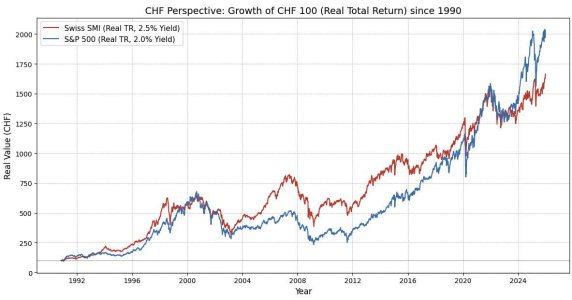
Some time ago I saw a chart of a World index quoted in euros: after the Dot-com crisis it stayed negative for 13 years. In USD it recovered much earlier.

Regarding diversification across multiple asset classes and the SWR, I’ll share this very well-designed website that shows many model portfolios. For each one you can look at a huge amount of data and charts. The most interesting chart is the “Withdrawal Rates” one, where you can see the SWR based on the number of years until retirement, as well as the PWR and LTWR:
Of course, the past doesn’t tell us what will happen in the future. But it does help us get a better idea.
 
Regarding diversification across multiple asset classes and the SWR, I’ll share this very well-designed website that shows many model portfolios. For each one you can look at a huge amount of data and charts. The most interesting chart is the “Withdrawal Rates” one, where you can see the SWR based on the number of years until retirement, as well as the PWR and LTWR:
The Home Country option is quite interesting. With US and 100% LCB I get an SWR of 3.6% for 35 years of retirement. If I change to CH, the SWR drops to 2.4% :(
 
Last edited:
The Home Country option is quite interesting. With US and 100% LCB I get an SWR of 3.6% for 35 years of retirement. If I change to CH, the SWR drops to 2.4% :(

The S&P 500 quoted in CHF was underwater for 16 years after the Dot-com bubble… a real blow for anyone in Switzerland who went into FIRE in 2000. This is why diversification is so important — not only across countries, but also across asset classes. Try adding bonds and gold and the SWR improves significantly.
 

Attachments

  • 56kzy93vx6ag1.jpeg
    56kzy93vx6ag1.jpeg
    91 KB · Views: 7
The S&P 500 quoted in CHF was underwater for 16 years after the Dot-com bubble… a real blow for anyone in Switzerland who went into FIRE in 2000.
Well, the S&P quoted in USD was underwater for 13 years after the Dot-com bubble. Are these 3 years of difference responsible for the SWR drop?..
 
Try adding bonds and gold and the SWR improves significantly.
That's astonishingly true. With 80% CHE LCB, 10% ITT bonds developed exUS and 10% gold the SWR jumps to 3,9%!

The so far highest SWR of 4% for Switzerland I get with 80% CHE LCB, 10% CHE ITT and 10% gold.

The calculator more or less says to invest in Swiss securities.
 
Last edited:
Are these 3 years of difference responsible for the SWR drop?..
No, not only that. It also depends on how much the market drops. And since the CHF is a safe-haven currency, when there’s a crisis it tends to increase in value (which means that if CHF is your reference currency, the market falls even more because of the exchange rate). This does happen — even in the last crisis during Trump’s term.

With 80% CHE LCB, 10% ITT bonds developed exUS and 10% gold the SWR jumps to 3,9%!
Yes, but I personally wouldn’t invest only in Swiss stocks. We don’t know where future crises will hit the hardest… the US, Switzerland, or somewhere else. From a geographical point of view, I just try to stay as diversified as possible. In technical terms this is called overfitting — when you optimise too much based on past data that doesn’t guarantee the same performance in the future.
Next year I’d like to try adding some alternative asset classes to my portfolio.
 
An even higher SWR of 4,5% (Switzerland, 35 years) is calculated for
  • 45% CHE LCB
  • 25% CHE ITT
  • 15% gold
  • 15% commodities
 
Last edited:
Regarding diversification across multiple asset classes and the SWR, I’ll share this very well-designed website that shows many model portfolios. For each one you can look at a huge amount of data and charts. The most interesting chart is the “Withdrawal Rates” one, where you can see the SWR based on the number of years until retirement, as well as the PWR and LTWR:
This calculator is quite nice and looks awesome, but I am not convinced it has enough data to draw conclusions. It only uses data from 1970 to 2024. This means that for a retirement of 30 years, it only has 24 starting years.

Additionally, I much prefer relying on success rate rather than a pure SWR. There are so many outcomes that aiming for 100% success rate is too constraining for me.
 
This calculator is quite nice and looks awesome, but I am not convinced it has enough data to draw conclusions. It only uses data from 1970 to 2024. This means that for a retirement of 30 years, it only has 24 starting years.

No, it doesn’t have enough data, and in any case I wouldn’t rely on it alone to decide when to go into FIRE. I mainly shared it to show that by diversifying across more asset classes you can achieve a better SWR, even if that comes with lower expected returns.
I also agree about the success rate — I don’t aim for 100%, I prefer something like 95%.
 
I’d be pretty cautious going above 3-3.5% for a 50 year FIRE horizon tbh, especially if you’re mostly in equities. A small cash buffer helped me sleep way better during rough markets lol.
 
I’d be pretty cautious going above 3-3.5% for a 50 year FIRE horizon tbh, especially if you’re mostly in equities. A small cash buffer helped me sleep way better during rough markets lol.
Are you worried about the worst duration of this strategy (ability to fail early)? The success rate is quite high, with 3.5% over 50 years.

A glidepath could help there I think.
 
Back
Top