Hi @Baptiste Wicht I'm curious why you plan to go 100% stocks, rather than a bond tent/ equity glidepath approach? Thank youGreat questions
I can answer based on our own strategy for FIRE, but it may not apply to your situation.
1. Currently, we aim for 3.8, but we will adapt until we reach retirement. 3.5% is likely fine. Our worst enemy as Swiss investors is the depreciation of USD.
2. We plan to go 100% stocks. But if you plan to be more conservative, a great strategy is an equity glidepath. You start with 20% bonds (or cash) for instance and you slowly sell them to go 100% stocks. This way, bonds, and stocks are doing what they are great for, respectively short and long term.
5. We plan to keep a house in retirement. Our plan for that is to have a long-term mortgage before we retire to avoid issues renewing it and prepare significant enough margin so that banks won't be deterred.

You are using an out of date browser. It may not display this or other websites correctly.
You should upgrade or use an alternative browser.
You should upgrade or use an alternative browser.
FIRE strategies for Swiss investors
- Thread starter Riches1
- Start date

Because my risk capacity allows itHi @Baptiste Wicht I'm curious why you plan to go 100% stocks, rather than a bond tent/ equity glidepath approach? Thank you

If I don't get income from my blog in early retirement, I will consider a glidepath from 80% stocks to 100% stocks to increase the safety.
AutonomousNerd
Member
What are the cheapest countries to live in comfortably (and safely)? If you don't need much and just want to chill and let your portfolio grow a bit more, while also living off of a part of the earnings: what place on earth would allow you to spend the least?
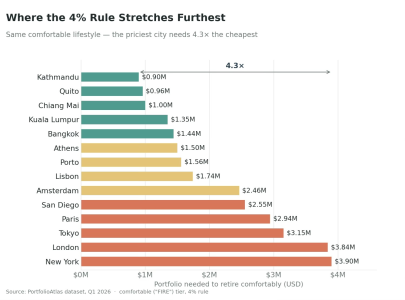
There is a free online tool called PortfolioAtlas that allows users to compare FI numbers in different countries and cities.
The creator of PortfolioAtlas also wrote an informative article that included this chart, it applies the 4% rule to several cities around the world.
VT and chill...... USD vs CHF
USD

 testfol.io
CHF
testfol.io

USD
Portfolio Backtester for ETFs and Asset Allocation | testfolio
Backtest portfolios, compare asset allocations, model rebalancing and cashflows, and analyze historical risk and return with testfolio.
CHF
Portfolio Backtester for ETFs and Asset Allocation | testfolio
Backtest portfolios, compare asset allocations, model rebalancing and cashflows, and analyze historical risk and return with testfolio.

Max
Active member
And why do you prefer 100% stocks rather than a mixed portfolio yielding a higher withdrawal rate?Because my risk capacity allows it
If I don't get income from my blog in early retirement, I will consider a glidepath from 80% stocks to 100% stocks to increase the safety.
I do not think a withdrawal rate of more than 4% is reasonable in retirement. I would consider CH bonds, but they are currently not interesting. The portfolio you are mentioning is too US-heavy for me. I want to keep my CH stocks in retirement as well.And why do you prefer 100% stocks rather than a mixed portfolio yielding a higher withdrawal rate?

Interesting. If I understand correctly, you will withdraw your full 2nd pillar as lump sum. This means that you will have to invested a significant portion in bonds. A challenging task with such choices of Swiss bonds.I want to keep my CH stocks in retirement as well.
As for my own situation, I am flirting with the idea of investing even my 2nd pillar in equity. But that's still far, far away.
Max
Active member
Why do you think so?I do not think a withdrawal rate of more than 4% is reasonable in retirement.
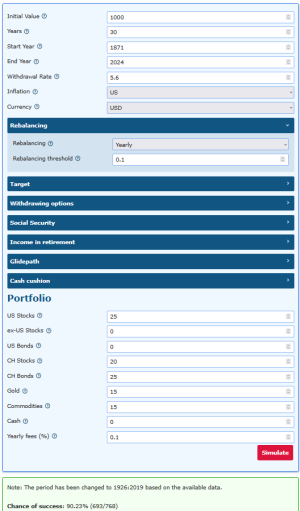
I have checked a mixed portfolio with CH stocks and CH bonds. The Advanced FIRE calculator counts 90% success rate for 5.6% withdrawal rate and 30 years of retirement (and 95% at 5.2%).I would consider CH bonds, but they are currently not interesting. The portfolio you are mentioning is too US-heavy for me. I want to keep my CH stocks in retirement as well.
For 40 years of retirement it counts 90% success at 4,95% withdrawal (and 95% success at 4,5% withdrawal).
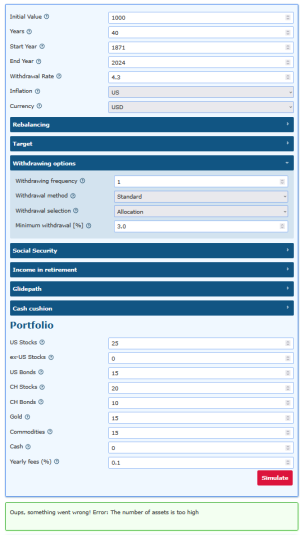
(If I further split bonds between US and CH, I get an error message "Oups, something went wrong! Error: The number of assets is too high".)
Last edited:
Actually I am keeping CH stocks not bondsInteresting. If I understand correctly, you will withdraw your full 2nd pillar as lump sum. This means that you will have to invested a significant portion in bonds. A challenging task with such choices of Swiss bonds.
As for my own situation, I am flirting with the idea of investing even my 2nd pillar in equity. But that's still far, far away.
It's probably doable in the US, but not in Switzerland when you have to deal with the uncertainty of the USD/CHF.Why do you think so?
Some of the withdrawal methods do not support many assets. Did you use a specific method?(If I further split bonds between US and CH, I get an error message "Oups, something went wrong! Error: The number of assets is too high".)
Max
Active member
Why do you think that the upper limit is 4%?It's probably doable in the US, but not in Switzerland when you have to deal with the uncertainty of the USD/CHF.
I didn't change the default settings.Some of the withdrawal methods do not support many assets. Did you use a specific method?
Because historically, the USD has lost value against the CHF, and I believe it will continue to do so. As a result, if we spend in CHF, we need to factor extra depreciation into account. And for me, this comes below 4%.Why do you think that the upper limit is 4%?
We have historical data for USD/CHF, but it's not really good because of the gold standard and the end of the Bretton Woods system.
Thanks, this should be fixed nowI didn't change the default settings.

Well, the depreciation cannot continue indefinitely. Of course, this is pure speculation from my side, but I think that we are close to the bottom of the depreciation.Because historically, the USD has lost value against the CHF, and I believe it will continue to do so.
Max
Active member
In my understanding, if we want to factor extra depreciation into account, we can subtract the expected long-term depreciation from any SWR calculated for US USD. Is it the way you come to 4%?Because historically, the USD has lost value against the CHF, and I believe it will continue to do so. As a result, if we spend in CHF, we need to factor extra depreciation into account. And for me, this comes below 4%.
Thanks, this should be fixed now
I hope you are right! But as you said, it's pure speculation. I prefer my early retirement to survive a drop rather than be too optimistic.Well, the depreciation cannot continue indefinitely. Of course, this is pure speculation from my side, but I think that we are close to the bottom of the depreciation.
More or less, yes. My portfolio would not be good with a 4.8% SWR, but more 4.5% and then I put it down to 3.8% to account for this.In my understanding, if we want to factor extra depreciation into account, we can subtract the expected long-term depreciation from any SWR calculated for US USD. Is it the way you come to 4%?
I am still far from retirement, so I may change my SWR by that time.
Max
Active member
How do you come to 0.7% which you subtract from 4.5%?More or less, yes. My portfolio would not be good with a 4.8% SWR, but more 4.5% and then I put it down to 3.8% to account for this.
BTW with which portfolio do you get 4.8%/4.5% SWR?
Last edited:
On average, I expect (heuristically) that USD will lose about 1% a year against the CHF. And I remove 30% of that since some of my assets will be in CHF. That's how I arrive at 0.7%. Keep in mind that it's very heuristic; it's not a sound method.How do you come to 0.7% which you subtract from 4.5%?
BTW with which portfolio do you get 4.8%/4.5% SWR?
I get about a 95% success rate with a 4.5% withdrawal with 40% US stocks / 40% ex-US stocks / 20% CH stocks in the calculator (including yearly rebalancing, and a small amount of social security after 20 years.BTW with which portfolio do you get 4.8%/4.5% SWR?
It can happenWell, the depreciation cannot continue indefinitely. Of course, this is pure speculation from my side, but I think that we are close to the bottom of the depreciation.
Regardless, equities involve risk taken for expected return. By increasing asset classes, you diversify risks, and overall, the portfolio achieves a better risk-adjusted return. Since the Safe Withdrawal Rate (SWR) drops significantly when calculated against deep and prolonged crises, relying on a single asset class is far from ideal. This is especially true for those of us living in CHF (see my previous message regarding VT in USD vs. CHF).
Equally important is the psychological aspect: one must be able to live with their portfolio and rely on it. You must also be able to sleep soundly at night.
I also add that while the calculated SWR and success probability are certainly important parameters for identifying the best portfolio, for planning my Financial Independence (FI) strategy, I utilize Monte Carlo simulations. This allows me to insert variables and plan my future most effectively. I’m including a link to the one created by Mr. Rip:
mr.rip/rp
Max
Active member
Your expectation is interesting because there is an estimation that USD has historically lost 2-3% per year. This estimation fits the historical difference in inflation between US and CH relatively well.On average, I expect (heuristically) that USD will lose about 1% a year against the CHF.
Why don't you remove 20% (you have 20% CH stocks)?And I remove 30% of that since some of my assets will be in CHF. That's how I arrive at 0.7%. Keep in mind that it's very heuristic; it's not a sound method.
I would guess it describes the 80% VT / 20% SPI portfolio. But in my calculation, 80% VT (which contains 61-62% US stocks) results in about 50% US stocks. Do you mean a different ETF?I get about a 95% success rate with a 4.5% withdrawal with 40% US stocks / 40% ex-US stocks / 20% CH stocks in the calculator (including yearly rebalancing, and a small amount of social security after 20 years.
Let's have a look at the following portfolio:
| Portfolio | Conditions | SWR @ 95% success rate | SWR - 0,7% |
| 30% US stocks 20% non-US stocks 20% CH stocks 15% gold 15% commodities | 40 years, US, USD, annual rebalancing | 4.9% | 4.2% |
Last edited:
Max
Active member
If we cut the tail with outliers we should still have ~50 years of data, shouldn't we? I think, 50 years is not bad - especially because we have problems with longer periods. Would it be a good idea to make calculations with those 50 years?We have historical data for USD/CHF, but it's not really good because of the gold standard and the end of the Bretton Woods system.
Indeed, historically, it has been higher. But I would say that since we are now low in the exchange, devaluation should be lower. Again, this is pure heuristic; we don't know, and we must adapt.Your expectation is interesting because there is an estimation that USD has historically lost 2-3% per year. This estimation fits the historical difference in inflation between US and CH relatively well.
What about you then? Do you plan to retire in Switzerland with a 4.5%+ withdrawal rate?
Because I expect to have a little income in CHF in retirement that will offset this.Why don't you remove 20% (you have 20% CH stocks)?
No, you are right. I just did it quickly on my calculator and did not think it through. It's indeed closer to 50% than to 40%,I would guess it describes the 80% VT / 20% SPI portfolio. But in my calculation, 80% VT (which contains 61-62% US stocks) results in about 50% US stocks. Do you mean a different ETF?
The problem is that if you have 50 years of data, you can only do a single 50-year retirement simulation. If you are limiting yourself to such a sample, you need to rely on something else than historical analysis.If we cut the tail with outliers we should still have ~50 years of data, shouldn't we? I think, 50 years is not bad - especially because we have problems with longer periods. Would it be a good idea to make calculations with those 50 years?