deimos1969
New member
Hi everyone,
While running the numbers on whether to buy property or keep renting in Switzerland, I found it difficult to get a complete picture using standard bank calculators or generic spreadsheets. They often oversimplify or completely miss the specific Swiss tax and mortgage mechanics.
I wanted to model exactly how the math works out over 10-30 years, specifically accounting for: • Eigenmietwert & Tax Shifts: How the imputed rental value shifts your marginal tax bracket vs. the deductions from mortgage interest and maintenance. • True Opportunity Cost: Comparing tying up down-payment equity in bricks vs. compounding it in an ETF (like VT or MSCI World). • Swiss Amortization: Factoring in the 2nd mortgage repayment schedule (down to 66% LTV within 15 years) and comparing the net-worth impact of Direct vs. Indirect (Pillar 3a) amortization. • Actual Running Costs: Comprehensive maintenance rules (0.5% - 1%) and ancillary fees (Nebenkosten).
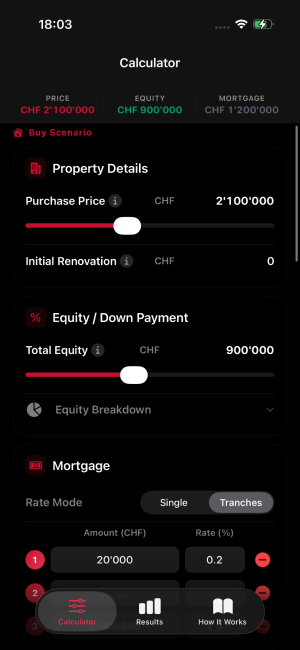
I ended up building a dedicated native iOS app called Buy vs Rent CH to handle these variables side-by-side and calculate the exact break-even point.
Since this community is incredibly knowledgeable about Swiss personal finance, I’d love to get your feedback to stress-test it. I want to make sure the underlying logic is rock solid. You can find it on the App Store by searching "Buy vs Rent CH".
I'm particularly curious:
While running the numbers on whether to buy property or keep renting in Switzerland, I found it difficult to get a complete picture using standard bank calculators or generic spreadsheets. They often oversimplify or completely miss the specific Swiss tax and mortgage mechanics.
I wanted to model exactly how the math works out over 10-30 years, specifically accounting for: • Eigenmietwert & Tax Shifts: How the imputed rental value shifts your marginal tax bracket vs. the deductions from mortgage interest and maintenance. • True Opportunity Cost: Comparing tying up down-payment equity in bricks vs. compounding it in an ETF (like VT or MSCI World). • Swiss Amortization: Factoring in the 2nd mortgage repayment schedule (down to 66% LTV within 15 years) and comparing the net-worth impact of Direct vs. Indirect (Pillar 3a) amortization. • Actual Running Costs: Comprehensive maintenance rules (0.5% - 1%) and ancillary fees (Nebenkosten).
I ended up building a dedicated native iOS app called Buy vs Rent CH to handle these variables side-by-side and calculate the exact break-even point.
Since this community is incredibly knowledgeable about Swiss personal finance, I’d love to get your feedback to stress-test it. I want to make sure the underlying logic is rock solid. You can find it on the App Store by searching "Buy vs Rent CH".
I'm particularly curious:
- How do you currently factor long-term ETF opportunity cost into your own homebuying calculations?
- What obscure Swiss tax edge cases am I probably missing in my engine?